
Archivi categoria: In English

Essays in English, written from scent as a way of thinking – sensoriality, geography, memory, transitions and a deeper understanding of the Earth.

Materia Viva n.7 — Black Mitcham Peppermint

Each issue of Materia Viva begins with an aromatic material and follows it the way one follows a trail: not only the scent, but the landscape, the history, the gestures, the images and the words that material carries with it.
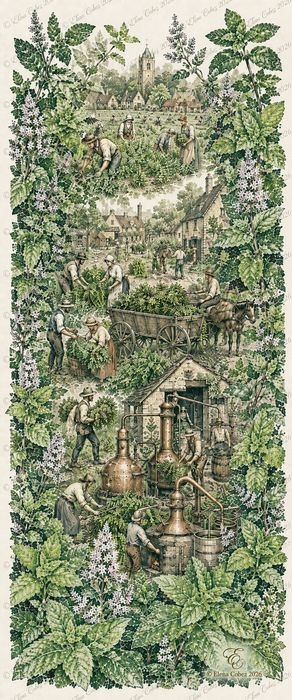
Mitcham Peppermint South London UK
Original artwork by Elena Cobez

This time the thread leads to Black Mitcham peppermint (Mentha × piperita), the variety born in the fields of Mitcham, south of London, where for two centuries mint growing shaped the landscape, the work and even the street names. A plant with a singular fate: being a sterile hybrid, it sets no fertile seed and propagates only by cutting. Every Black Mitcham plant is, quite literally, the living continuation of one and the same individual — an unbroken green thread running through centuries and through wars.

In the summer of 2026 this issue was accessioned as an archival source by the Wandle Industrial Museum, as documentation of the historic mint cultivation of the Mitcham area.

The issue moves through the Mitcham fields and their memory, the English distilleries, and the rescue of the variety during the First World War — a history, and a plant, with a good many surprises in store.

A PDF copy is available on request. For that, and for anything about the project or how to support it, write to professionefelice@gmail.com — or use the WhatsApp button on the site.

[Questo articolo è disponibile in italiano qui]

Materia Viva n.5, the Aromatic Ezine – Camellia japonica, the Japanese Camellia

Materia Viva is a work in progress dedicated to aromatic raw materials: resins, plants, woods, essences, balsams, flowers, seeds, roots.

It arises where scent, word, image, and research meet. Of each material, what matters is not only its effect, but everything that accompanies it: where it comes from, which landscape generates it, which hands have gathered it, how it has become a symbol.

It is at once a cultural notebook and a sensory experience. Each material is traced back to its origin, through lands and customs, ancient trade routes, archives, faces, and sudden intuitions. Starting from a resin, a wood, a flower, the thread is followed: clues are gathered, the scent is listened to, an image is pursued, until a form surfaces.

Part of this work lives in texts and digital publications; another part becomes original artwork, printed in fine art.

The latest issue is dedicated to Camellia japonica. Here is an excerpt:

I close my eyes. My fingertips move across the skin of my face — tapping lightly, tracing small circles. I use an oil that flows easily, weightless to the touch. I bring my fingers to my nose, and this time the scent is the faintest thing: no floral fragrance, but rather a delicacy that speaks directly to the skin — making it immediately supple, glad. This is how I first meet Camellia japonica, a plant with full, red flowers that seems at first to promise perfume, and instead delivers care through the oil pressed from its seeds.

You can receive a free PDF copy by writing to us via the WhatsApp button on the site. Read more about Materia Viva, or continue to the next issue: Black Mitcham Peppermint