
Each issue of Materia Viva begins with an aromatic material and follows it as one might follow a trail: not only its scent, but the landscape, history, gestures, images and words that the material carries with it.
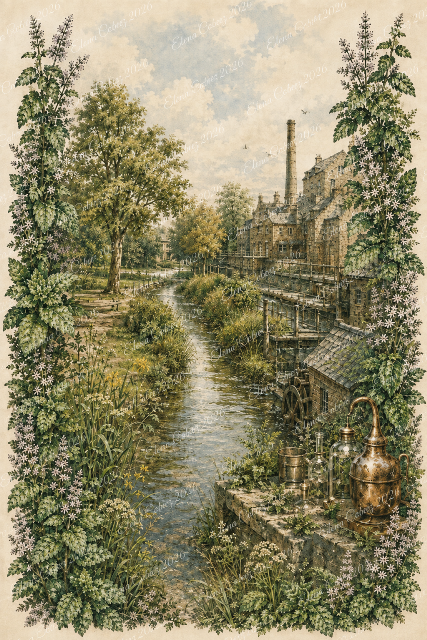
This time, the thread leads to a river: the Wandle, nine miles of water flowing from the hills south of London to the Thames. It rises from chalk, and that explains much of what follows: rain filters for months through the porous rock before re-emerging as spring water, cold and clear in every season.
An entire district of trades grew up around that water. The damp meadows along the river supported mint and chamomile, while lavender grew further away where the soil became more gravelly, and the same stills were used to distil them. Further downstream, mills ground tobacco for snuff. At Merton Abbey, William Morris moved his entire production in 1881, after having the river water analysed to make sure it was suitable for printing with vegetable dyes.
It is a story of water and hands. Of a single current that, over nine miles, allowed very different trades to exist — growers, distillers, dyers — all sustained by the same natural resource: crystal-clear water.
A recent special edition of the e-zine was also devoted to Mitcham peppermint, tracing the history of this aromatic plant through the landscape, people and industrial heritage of south London.
You can receive a free PDF copy, and for further details about the project and how to support it, contact us via the WhatsApp button on the website or by email at professionefelice@gmail.com.