
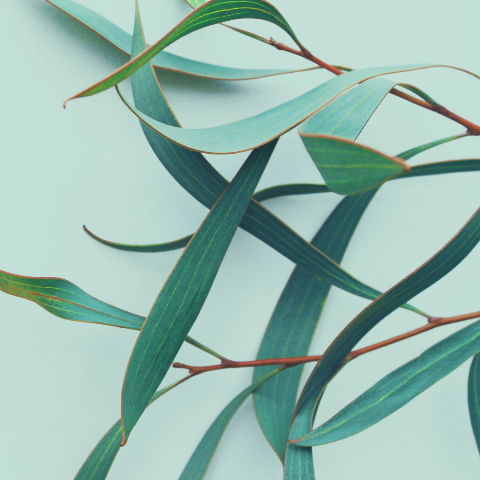
Perhaps not everyone knows that young eucalyptus trees have blue-green leaves that characterise them so much that they have been given a name for them – the Eucaliptus globulus is called Gommier bleu in French and Blue Gum tree in English.
These trees, which are found almost all over the world today, were spread to Europe in the 1800s, and are native to Australia and Tasmania (actually, they appear to be even older because they were present on the prehistoric continent, dating back several million years, from which Australia and South America originated). Koalas are fond of Eucalyptus leaves, and in local traditional medicine the properties of this plant have been known ‘forever’.
There are more than 800 species of Eucalyptus – an evergreen tree with hardy leaves that evolves over time, so that it has a juvenile form and an adult form with different characteristics.
In aromatherapy, we know it for its essential oil, which is rich in respiratory benefits, but not only. There are several extractions of Eucalyptus, but here we will focus on three essences in particular:
Eucaliptus globulus: anti-catarrhal, antibacterial, antiviral, has an intense fragrance containing 80% cineole, sometimes too much for sensitive people and children – in this case we prefer radiata.
Eucaliptus radiata: expectorant, antibacterial, antiviral, with stimulating qualities useful in cases of profound fatigue.
Eucaliptus citriodora: anti-inflammatory, anti-rheumatic, has qualities quite different from the ‘respiratory’ eucalypts, and should therefore not be confused with them. It has a citrine scent, and calming properties, also due to the presence of citronellal.
From an emotional point of view, if we breathe in Eucaliptus globulus or radiata, we will feel the breath expand, bringing us more centredness and the ability to express what we have inside – really useful if we feel an emotional burden and need to ‘air out’ our inner spaces ? ? For breathing properties, it can be diffused.
For respiratory properties, you can diffuse a few drops of Eucalyptus with a diffuser, remembering that in the case of asthma, be careful and never ingest the essence.
For the anti-inflammatory properties of citriodora we can add a few drops to a cream, or base oil, and smear it on the desired area. The scent might not be the most pleasant, but the benefit outweighs the smell!