
Archivi tag: aromatic plants

Materia Viva n.11 – Kua Myrrh

Every issue of Materia Viva begins with an aromatic material and follows it the way one follows a trail: not only the scent, but the landscape, the history, the gestures, the images and the words that the material carries with it.

This time the thread leads to northern Kenya, where Samburu women gather kua myrrh, Commiphora kua, picking off with their fingers the drops that the tree lets out by itself. Here kua is never cut: what the plant offers is what is taken, and the tree stays whole. For a long time this resin ended up anonymous in sacks, mixed with more common myrrhs. Today it has begun to be recognized and gathered separately, and that small gesture of separation makes it identifiable and brings those who harvest it an income of their own.

On the nose it surprises anyone expecting myrrh: in place of the bitter, earthy base, sweet notes of wood and vanilla and a balsamic touch, almost velvety. It is a relative of Omumbiri from Namibia, another Commiphora that carries with it the gesture of the women who gather it.

Discover more about Materia Viva – and if you love resins, the previous issue is on Ramy, a resin from Madagascar.

The ezine is an editorial project supported by private funds, and you can receive a free PDF copy. For every detail on the project and on how to support it, write to us through the WhatsApp button on the site or by email: professionefelice@gmail.com
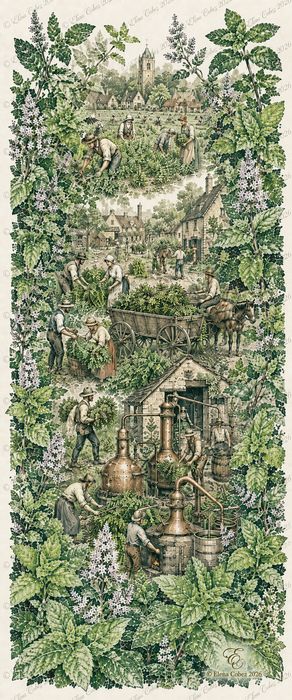
Materia Viva n.7 — Black Mitcham Peppermint

Each issue of Materia Viva begins with an aromatic material and follows it the way one follows a trail: not only the scent, but the landscape, the history, the gestures, the images and the words that material carries with it.

Mitcham Peppermint South London UK
Original artwork by Elena Cobez

This time the thread leads to Black Mitcham peppermint (Mentha × piperita), the variety born in the fields of Mitcham, south of London, where for two centuries mint growing shaped the landscape, the work and even the street names. A plant with a singular fate: being a sterile hybrid, it sets no fertile seed and propagates only by cutting. Every Black Mitcham plant is, quite literally, the living continuation of one and the same individual — an unbroken green thread running through centuries and through wars.

In the summer of 2026 this issue was accessioned as an archival source by the Wandle Industrial Museum, as documentation of the historic mint cultivation of the Mitcham area.

The issue moves through the Mitcham fields and their memory, the English distilleries, and the rescue of the variety during the First World War — a history, and a plant, with a good many surprises in store.

A PDF copy is available on request. For that, and for anything about the project or how to support it, write to professionefelice@gmail.com — or use the WhatsApp button on the site.

[Questo articolo è disponibile in italiano qui]